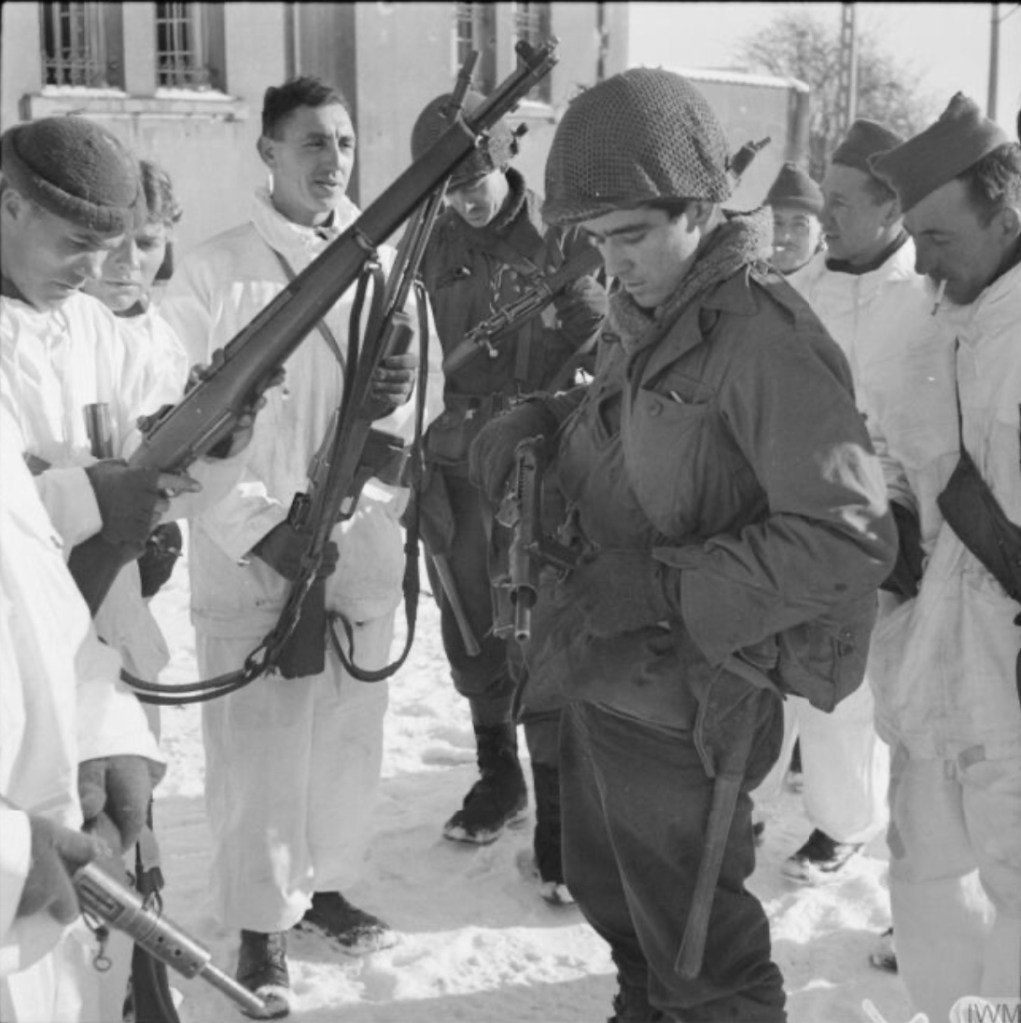
https://www.iwm.org.uk/collections/item/object/205202992 THE BRITISH ARMY IN NORTH-WEST EUROPE 1944-1945. © IWM (B 13691)
Given that the Battle of the Bulge was mainly fought by American forces, it’s no surprise that the other Allied nations are often forgotten in discussing the bitter fighting of December 1944 and January 1945. By Christmas 1944, the British Army had been pushed to its breaking point. After countless campaigns in the Middle East, North Africa, and Mediterranean, the Normandy Campaign had devastated the British Army. “The Army’s monthly battle casualty rate as it fought its way out of the D-Day bridgehead from June to September 1944 was more than twice what it had averaged in France during the First World War. […] By the end of August 1944, all the British infantry divisions in Normandy had lost three-quarters of their initial fighting strength” (Allport, Browned Off and Bloody Minded, xix; 184-185). Some veteran units, such as the 50th Infantry Division, were pulled off the line and broken up, with some men returning to England to act as a training unit and other sent to units still fighting at the front.
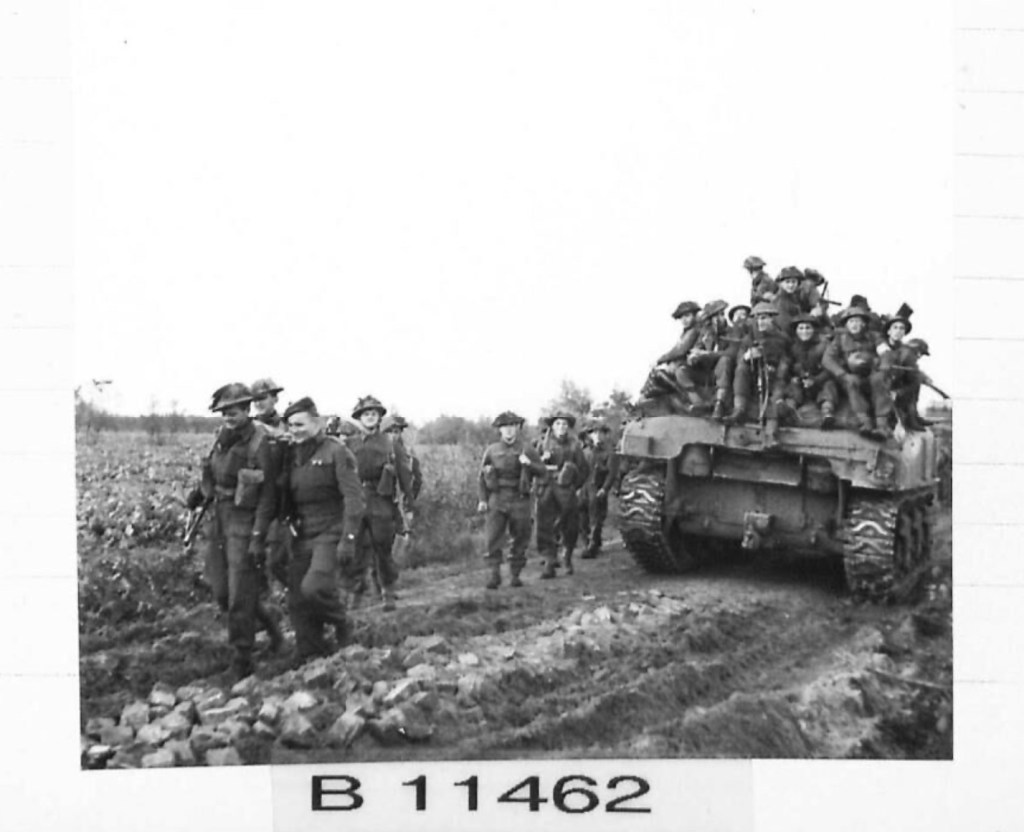
https://www.iwm.org.uk/collections/item/object/205411268%5D51 HIGHLAND DIV ATTACK TOWARDS SPRANG. © IWM (B 11462)
The PBIs were likewise exhausted. Squaddies, slang for the common British infantrymen, like Stanley Whitehouse of the Scottish 51st Highland Division prayed that winter might to promise some much-needed calm. “About this time, I began to experience more acute symptoms of ‘bomb happiness’ or ‘shellshock’ as it was called in the earlier Great War. I had been in the line now, almost continuously, for more than six months and as week succeeded week I was having to dig deeper and deeper into those innermost resources of resolution, endurance and zeal to combat the growing, nagging fearfulness that filled my waking and often sleeping hours. I came to realize that for all the enemy’s skill and doggedness he was more easily overcome than my troubled, tortured mind. I had long since forsaken that spirit of adventure, that devil-may-care attitude that had sustained me in the early days, when mates all around me were being killed and horribly maimed, and the whiplash of the murderous Spandau and the crunch of the mortars had men quivering in the bottom of their ‘slitters’” (Whitehouse and Bennett, Fear is the Foe, 125). In his memoir, Whitehouse writes vividly of planning to desert by the Winter of 1944 and very nearly shoots himself in his hand before he’s interrupted by a comrade. Morale was low, but with Christmas only a few weeks away, squaddies daydreamed of “something special in our rations, and maybe extra mail. The line had been extremely quiet and one or two of the more optimistic squaddies even ventured to suggest a spot of leave might be in the offing” (Whitehouse and Bennett, Fear is the Foe, 134). Unfortunately for Whitehouse and his mates, Unternehmen Wacht am Rhein (Operation Watch on the Rhine) shattered any dreams of a truly peaceful Christmas.
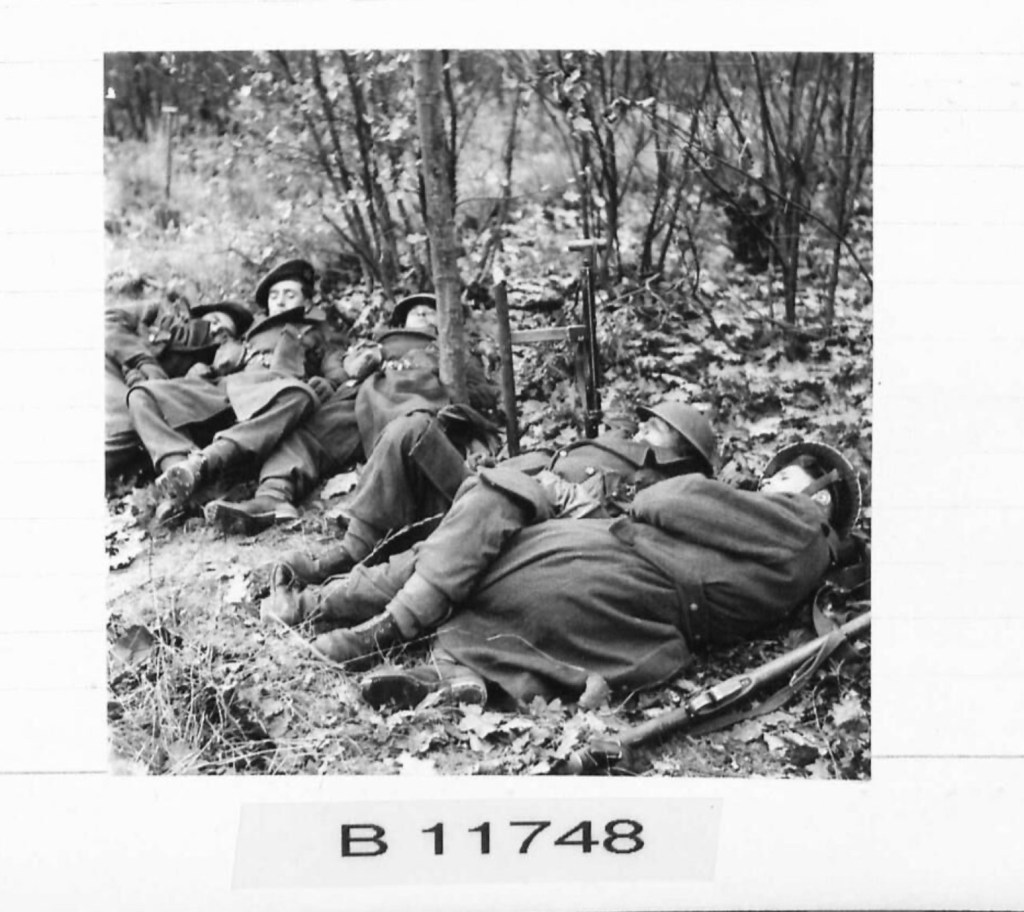
51 HIGHLAND DIV. PUSH ENEMY TO THE MAAS © IWM (B 11748)
When Allied High Command realized the scale of German General Von Rundstedt’s breakthrough in the Ardennes on 16th December 1944, General Eisenhower ordered General Montgomery “to take command of the US 9th Army, and the US 1st Army” to stop and counterattack the German forces that had seized the Belgian towns of Hutton, Marche, and Laroche (Delaforce, Monty’s Highlanders, 194). Monty also organized battle-hardened British units into a quick response force near the Louvain – St Trond sector, including the 29th Armored Brigade of the 11th Armored Division, the 30th Corps composed of the Guards Armored, 43rd Wessex, 53rd Welsh, and 51st Highland Divisions, to be thrown into action if there was another German breakthrough (ibid). To their great relief, the squaddies in this response force were LOB (left out of battle) for Christmas, New Years, and Hogmanay (a traditional Scottish New Years holiday), with the primary casualties being the “splendid Christmas Dinner with American Rations” or “roast pork, roast potatoes, Christmas pudding [and] beer” depending on the unit (ibid, 194, 196). At least some Tommies received a deserved 48 or 72 hour pass to Brussels, including 5th Cameron NCO Ronald Hann, who was able to sleep in a real bed for the first time in months (Hann, IWM, Reel 2, 26:09), The festivities were somewhat hampered by “the most severe winter […] for more than fifty years” (Whitehouse and Bennett, Fear is the Foe, 134). The freezing conditions caused “our personal weapons [to freeze] up and to cock a rifle we had to hammer the bolt in position with a piece of wood, a stone or any other handy object” and in one later engagement caused an entire unit’s weapons to become useless in a firefight (Whitehouse, Fear is the Foe, 134-135; 138). “Little tracked ‘weasels’ and jeeps were the only vehicles that could be relied on and sledges were used to ferry up ammo and rations” (Delaforce, Monty’s Highlanders, 197).
As reports and rumors of German infiltrators wearing American uniforms spread, both American and British forces became increasingly jumpy (Delaforce, Monty’s Highlanders, 196). Officers of the 5th Camerons celebrating Hogmanay nearly became casualties when heading to a party at a local café. “At a road block, the rather nervous American sentries asked pertinent questions ‘What’s the capital of California?’ ‘Who won the World Series [baseball]?’ [Scout Platoon Commander Lt Ross Le Mesurier] piped up from the back of the jeep ‘The St Louis Cardinals beat the St Louis Browns four games to three.’ The GIs at the roadblock were baffled by a Canadian in a Scottish battalion with drafty kilts, etc. However [they] passed through and all started the party with a double Scotch!’ (Delaforce, Monty’s Highlanders, 197).
The relative calm for the squaddies broke on 7 January 1945 when the 51st Highlanders launched a counterattack Southeast toward Laroche. Intense skirmishes and dangerous temperatures caused many casualties as the Tommies advanced over the next week with one veteran recalling about 60 KIA and more wounded across the 51st Division (White, IMW, Reel 3, 21:31).
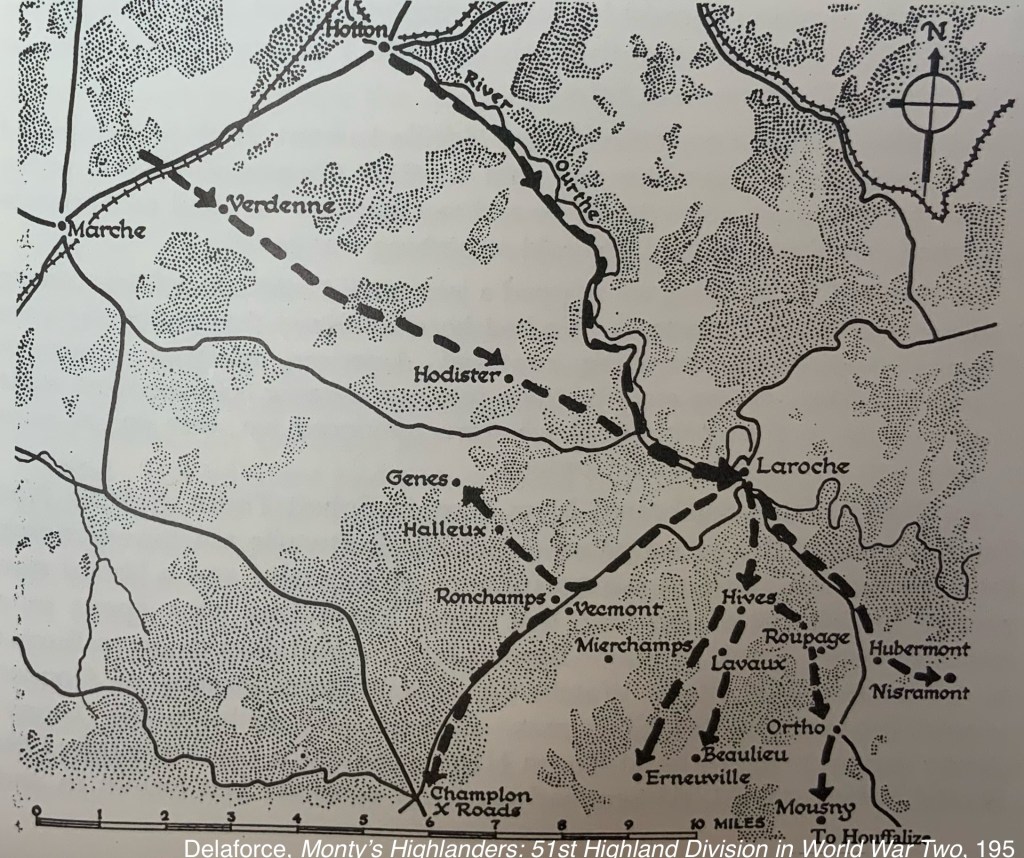
On 14 January 1945 a rather odd patrol of the Scout Platoon of Company A, 5th Camerons, 51st Highland Division made contact with both an SAS detachment from the British 6th Airborne, which was operating to the South of the Highlanders, and the 84th Infantry Division. Besides the linkup of these three units around the Champlon crossroads, sources diverge on what happened that day. According to L/Sgt Lelsie L. Toogood, a member of the Cameron Scout Platoon: “We set out early on the 14th, [from the village of Journal] heading for the crossroads of Barriere Champlon. Four men carried on to the crossroads. On our way we encountered a SAS officer. He and his Sergeant were escorted back, whilst four men carried on to the crossroads to set up an observation post, to cover our backs before the rest of us searched Champlon. Fortunately the enemy had departed from the village when we entered. We then spotted a section of infantry working it’s way toward the village from the direction of Tenneville. Our first thought was they were Germans. We were more than a little relieved when they turned out to be American troops. We were immediately taken to their Intelligence Officer, who was given all details of the area patrolled and the location of our Battalion HQ. We were given coffee and food before returning to our lines. By the time we got back news of our contact had already been received over the wireless” (http://ww2f.com/threads/brits-in-the-ardennes-44-45.38948/).
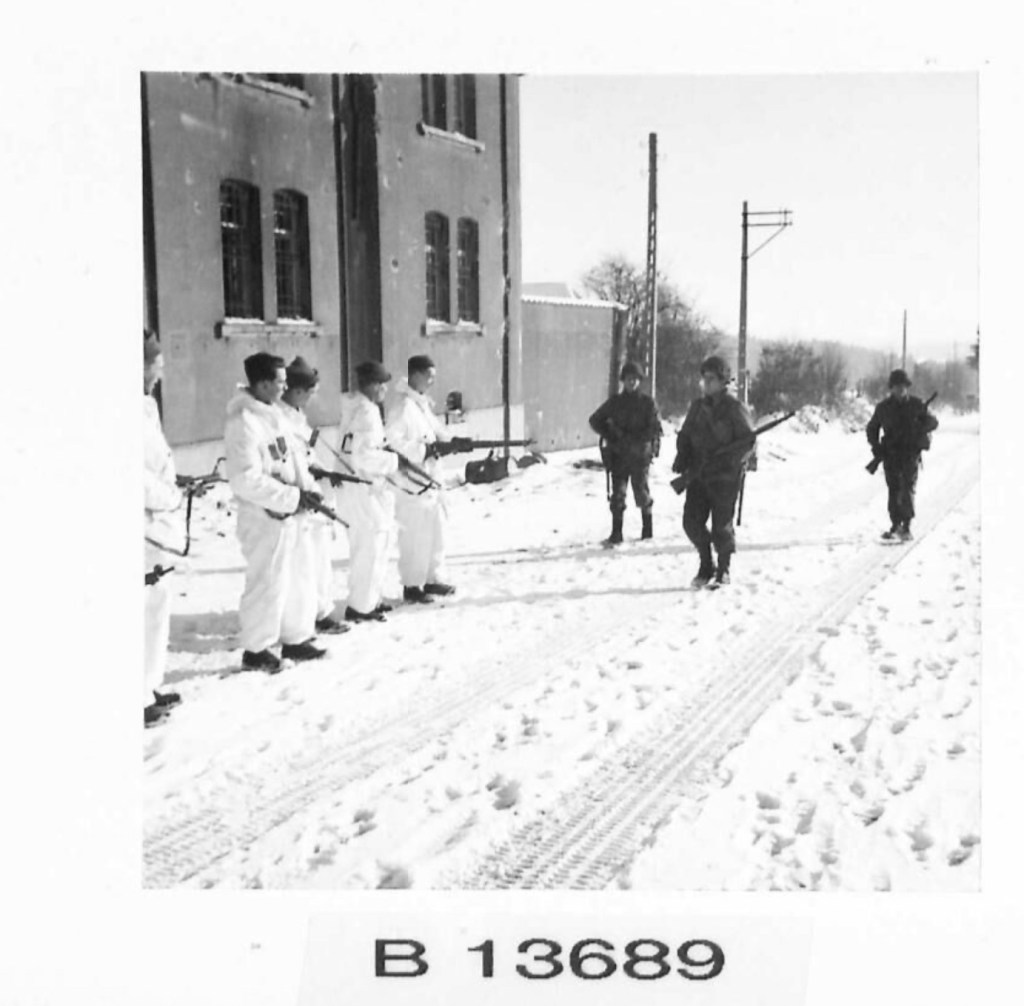
LINK UP OF ALLIED ARMIES © IWM (B 13689)
The War Diary of the 5th Camerons states for Jan 14th: “One party of scouts under Capt.MACDONALD met a patrol of the American 3rd Army. This caused great excitement as they were the first people to meet men belonging to the American Army advancing up from the South. One A Coy patrol was photographed by a movietone news man, and another party under de Second-in-Command, Major MUNRO and our Dutch L.O. had the pleasure of making a recording for the B.B.C. Major MELVILLE and Capt. LEE took the first vehicle through to a forward American Company Headquarters” (http://ww2f.com/threads/brits-in-the-ardennes-44-45.38948/).
Yet in an interview well after the war, one participant of this historic meetup, Private Charles Edwin White remembers a rather different story. White had served as an NCO with the 5th Cameron at the front since D-Day+1 but, after cursing out a Major, was busted to Private by the Ardennes. In a 2001 interview, White recalls his sergeant ordering him to pack four haversack rations and choose three men to cover some Engineers removing Tellermines. When he protested that he was just a Private and there were at least a few other NCOs in the outfit, his sergeant told him that he was the only person in area with experience as an NCO and he better get moving. After cleaning the mines, the engineers returned back and his patrol stayed in place. Around midday, White said , “coming down the road were two Yanks! […] We got chatting with them, us four. […] A little while after, the rest of A Company come up, and Lt Rickabee was our platoon commander, and they said “the news people are going to come up and we want to film all this linking up with the Yanks, see?” So they photographed me shanking hands with one and one or two of the others shanking hands with one. A lot of things were put on, they said “we want it to look proper” so they got the platoon to stand near a crossroads and one by one come out from the crossroads and meet the Yanks coming from the other way, cause its probably all good for the Yanks. Anyway that’s what we did and that’s when they photographed the whole of us, you know we were in our white smocks on, and that’s where I am in that.” (White, IWM, Reel 3, 18:07).
Want to represent the Scout Company of Coy A, 5th Camerons at a Living History event?

Pte Johnson of Speke, Liverpool, at work with his wireless set on the crossroads at Champlon. He was a member of a recce patrol sent out from the 5th Queen’s Own Camerons Highlanders, 51 Div. All are wearing white camouflage suits.
LINK UP OF ALLIED ARMIES © IWM (B 13687)
Here’s a breakdown of kit (which can mostly be bought from What Price Glory or SOF):
Snow Suit:
https://onlinemilitaria.net/products/8800-british-snow-camo-white-oversmock/
https://onlinemilitaria.net/products/8793-british-snow-camo-white-overtrousers/
With P-37 Gaiters from WPG or SOF:
https://www.sofmilitary.co.uk/1937-british-canvas-gaiters-by-kay-canvas.html
Bandolier:
https://www.sofmilitary.co.uk/lee-enfield-303-cotton-bandolier.html
Ammo boots:
https://www.smwholesaleusa.com/shop-footwear/wwii-british-ammo-boots?rq=british
(SOF and WPG often have these too.)
Cap:
https://www.sofmilitary.co.uk/ww2-british-army-commando-cap.html
https://onlinemilitaria.net/products/4092-uk-cap-comforters-khaki-indian-army/
Relevant Sources:
Monty’s Highlanders: 51st Highland Division in World War Two by Patrick Delaforce
Fear is the Foe: A Footslogger from Normandy to the Rhine by Stanley Whitehouse and George B. Bennett
Hann, Ronald (Oral History)
https://www.iwm.org.uk/collections/item/object/80019561
White, Charles Edwin (Oral History)
https://www.iwm.org.uk/collections/item/object/80020774
Good Websites on the 51st:
https://www.unithistories.com/units_british/51InfDiv.html
http://www.keep-em-moving.co.uk/page1.html
Old forum discussing this event:
 The Smiley GI